
The ex-dividend date is the only date that matters: buy before it, you get the dividend; buy on or after, you do not. The payout date is just when cash arrives. So a payout calendar app earns its keep by watching ex-dates across everything you own. The next feature buyers ask for is monthly income, and that is where the calendar runs into a wall. In our database of 197 dividend stocks, the count of monthly dividend kings is zero.
Counted: the kings all pay quarterly
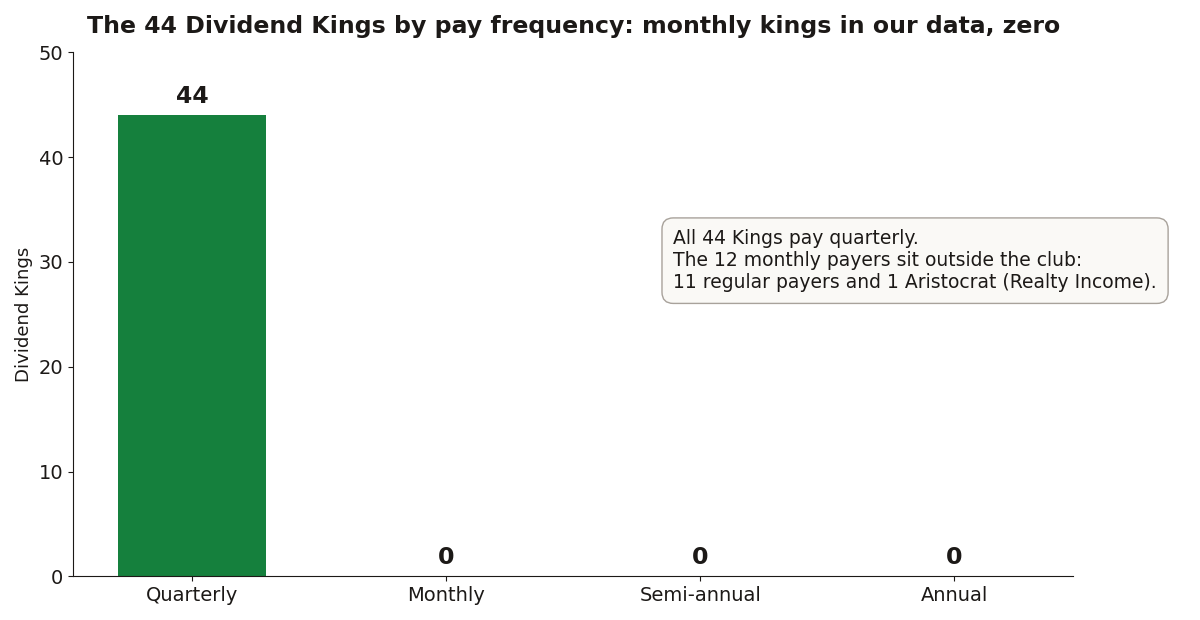
Every one of the 44 kings in the database pays quarterly. None pays monthly, none semi-annually, none annually. The 12 monthly payers are a different crowd entirely: 11 regular payers plus a single aristocrat, Realty Income, which pairs monthly payments with a 31-year increase streak and a 5.4 percent yield. The median increase streak among the 12 monthly payers is 0 years, against a median of 16 years among the quarterly payers. Monthly cash and a half-century of raises do not currently coexist, and any calendar view that pretends otherwise is decorating, not informing.
What a payout calendar should show
A payout calendar app should show: ex-dates for your holdings, declaration dates, payout dates, and a monthly income view. Stock Events does this best on both platforms; Snowball adds forward projections. The monthly income view is where the kings problem gets solved rather than hidden. Since quarterly payers land in different months, a calendar that groups by pay month turns the 181 quarterly payers in the database into something close to a monthly paycheck, with streaks the monthly 12 cannot offer. Three staggered groups of quarterly payers, one landing each month, is the honest version of monthly dividend income.
Two mechanics people miss. Dividends declared but not yet paid still count as income you are owed, and foreign dividends arrive net of withholding tax, 15 percent for many treaties and 30 percent by default. The calendar also has to cope with the oddballs at the edges of the database: Vornado Realty Trust and Turkcell pay annually, while Fox Corporation and America Movil pay semi-annually, so a rigid quarterly template quietly drops four stocks.
Staggering, worked through
Staggering sounds abstract until you build it. Take the quarterly majority and sort holdings by the months their dividends land. One group paying early in each quarter, one in the middle month and one in the last month turns four payments a year per stock into twelve payment months per portfolio. The calendar app is what keeps the groups honest: ex-dates drift, companies occasionally move a payment, and a declared dividend shows up in the calendar weeks before the cash does. Without the app, the stagger exists on a spreadsheet you stopped updating in March.
The planning side matters too. When a sample portfolio is assembled from an income target, the frequency mix is a real choice: lean on the 12 monthly payers and accept the real estate and financial concentration, or build from the 181 quarterly payers and stagger. The second route usually wins on streaks alone, since the quarterly median streak is 16 years and the monthly median is zero. The calendar then does the smoothing that the monthly payers were supposed to do.
The monthly habit
Build the calendar habit monthly: review next month's expected payouts, confirm any DRIP settings, and check for announced cuts. Fifteen minutes a month prevents the classic mistake of buying a stock the day after it went ex-dividend. It also catches the quieter mistake, assuming a holding pays monthly because its name sits in a monthly list somewhere, when the database says quarterly and always did.
Plan the income the calendar shows
The calendar shows what your current holdings will pay and when. Planning is the step before it: the Dividend Income Builder takes a target monthly income and your capital and builds a sample portfolio from the same 197 stocks counted here, so the pay months can be staggered on purpose instead of discovered later. Pair the plan with the calendar, check the ex-dates monthly, and the monthly dividend kings stop being a product you hunt for and become a schedule you built. This is educational content, not financial advice.
Sources: Nasdaq, Morningstar